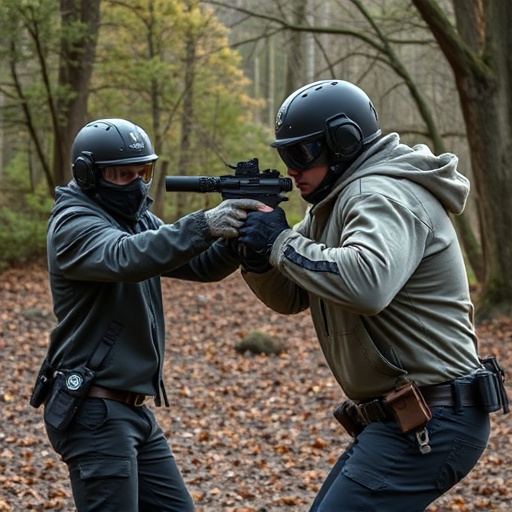
Altitude significantly impacts pepper spray's range and effectiveness, with reduced air pressure causing wider spread but lower concentration. Temperature variations affect spray patterns. High-altitude environments increase risks of respiratory issues and skin irritation. Riot control canisters optimized for consistent performance at varying elevations, but global regulations differ. Understanding altitude effects is crucial for safe and effective crowd control worldwide.
“Explore the multifaceted world of riot control inflammatory spray canisters, with a focus on the intriguing factors shaping their performance at varying altitudes. Understanding the ‘Altitude’s Impact on Spray Range and Effectiveness’ is key, as it reveals how elevation influences the range and potency of pepper spray. This article delves into health risks associated with inhalation and skin irritation at high altitudes, offering insights into strategic canister design for optimal tactical applications. We also examine global regulatory measures to ensure safety in diverse environments.”
- Altitude's Impact on Spray Range and Effectiveness
- Health Risks: Inhalation and Skin Irritation at High Altitudes
- Strategic Use of Canister Design for Optimal Performance
- Global Perspectives on Regulatory and Safety Measures
Altitude's Impact on Spray Range and Effectiveness
The altitude at which a riot control inflammatory spray canister is deployed can significantly impact its range and effectiveness. As elevation increases, air pressure decreases, leading to changes in the dispersion and penetration of the pepper spray particles. At higher altitudes, the reduced atmospheric pressure causes the spray mist to spread more widely, potentially reducing its concentration near the target area. This effect can be particularly noticeable in mountainous regions or urban areas with elevated points, affecting both the reach and impact of the spray.
Moreover, temperature variations at different altitudes can also play a role in how pepper spray performs. Colder air is denser, which could lead to a more focused spray pattern when combined with lower pressure. Conversely, warmer air at lower elevations might cause the spray to dissipate more quickly due to increased air movement and reduced viscosity of the spray solution. Understanding these altitude effects is crucial for tactical planning in various environments, ensuring that riot control strategies are optimized for maximum effectiveness.
Health Risks: Inhalation and Skin Irritation at High Altitudes
At high altitudes, the effects of riot control inflammatory spray canisters, often known as pepper spray, can be amplified. Inhalation of the spray’s chemical agents becomes a more significant health risk in thin air, where gases and vapours remain suspended for longer periods, increasing the likelihood of deep lung irritation and potential respiratory issues. This is particularly concerning for individuals with pre-existing respiratory conditions or asthma.
Moreover, skin irritation can be intensified at higher altitudes due to reduced atmospheric pressure. The body’s natural protective mechanisms against irritants are diminished, making individuals more susceptible to chemical burns and prolonged discomfort. In extreme cases, altitude effects on pepper spray can lead to temporary incapacitation and even severe health complications, underscoring the importance of considering these factors when assessing riot control strategies in mountainous regions or high-altitude environments.
Strategic Use of Canister Design for Optimal Performance
The design of riot control inflammatory spray canisters plays a strategic role in optimizing performance, particularly at varying altitudes. In high-altitude environments, air pressure decreases, affecting the spray pattern and intensity. Canister designs adapt to counteract these effects, ensuring that pepper spray reaches its intended targets consistently. This is crucial for effective crowd control during protests or civil unrest in mountainous regions.
Manufacturers incorporate specific features like enhanced nozzles and pressurized gas systems to compensate for altitude-related challenges. Such innovations guarantee that the spray maintains its potency and accuracy at different elevations, making it a versatile tool for law enforcement agencies worldwide.
Global Perspectives on Regulatory and Safety Measures
Global perspectives on regulatory and safety measures for riot control inflammatory spray canisters vary widely, reflecting differing cultural, legal, and social contexts. In some countries, strict regulations govern the production, distribution, and use of pepper spray, with robust safety protocols in place to protect both users and bystanders. These stringent rules often incorporate rigorous training programs for law enforcement agencies and mandatory equipment standards. Conversely, other regions have more lenient laws, allowing for broader access and less oversight, which can lead to varying levels of safety and accountability.
Altitude effects on pepper spray are another significant consideration, as the changing atmospheric conditions at higher elevations can impact the effectiveness and range of the agents. Studies show that temperature, humidity, and air pressure variations can alter the dispersion and potency of inflammatory sprays, necessitating adjustments in deployment strategies for riot control scenarios. Understanding these global disparities and altitude-related factors is crucial for harmonizing international standards and ensuring consistent safety measures worldwide.
In conclusion, understanding the altitude’s impact on spray range and effectiveness, along with its effects on health at high altitudes, is crucial for strategic deployment of riot control inflammatory spray canisters. Optimizing canister design to achieve optimal performance in diverse environments, coupled with global harmonization of regulatory and safety measures, ensures that law enforcement agencies can effectively manage crowd control while mitigating risks to both officers and civilians. Knowing the “altitude effects on pepper spray” allows for better preparedness and enhanced safety protocols in various geographic settings.